Knowing how to interpret surf forecast is one of those skills every surf enthusiast wants to have, in order to know what to expect and plan their sessions. It may seem complicated, and if you haven’t spent time on it yet or have found it difficult so far, you’ll see that with these guidelines it will be much easier to read surf forecasts and understand what the ocean will be like in the coming days at your favorite spots.
How to read surf forecast
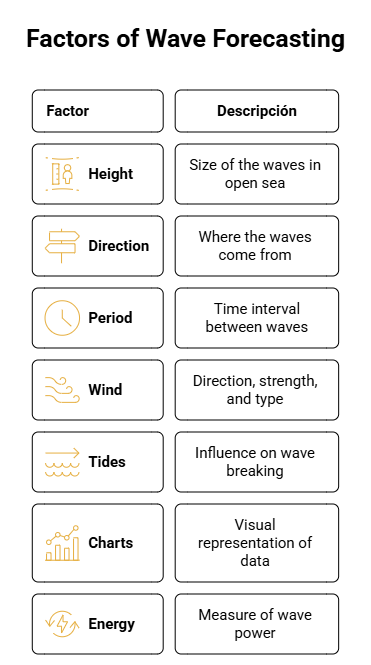
To make a good surf forecast, it’s necessary to understand and take into account several factors. This way, when you visit websites that provide wave forecasts for surfers, you’ll be able to easily interpret their charts and data.
If you want to learn everything you need in order to enjoy this sport with personalized attention suited to your level, sign up for a private surf lesson at surfintrip.com.
Swells and what to look for in surf forecast
There are three main factors to consider when talking about waves forecast and swells: wave height or size in open water, wave direction—which indicates where the waves are coming from—and wave period, which shows their power and quality.
Height is the easiest data point to interpret and, depending on the website, it may be shown in meters or feet.
Direction is another key factor in surf forecast: you need to observe whether the waves are coming straight toward the coast, at an angle, or from another direction, since waves that arrive directly are more powerful.
The period is the time interval between one wave and the next and is measured in seconds. It indicates wave power: a longer period—meaning more seconds—points to better surfing conditions than a wave of the same height with a shorter period, as waves will be more organized and more powerful. As a result, the period can cause the actual wave height, when it hits a sandy or rocky bottom, to be much greater than the forecast height. A period above 12 seconds is considered long, while below 10 seconds is considered short.
Another factor to consider, closely linked to the period, is the fetch—the distance over the ocean across which the wind blows without encountering any barrier. The longer the fetch, the longer the period and, consequently, the greater the power and size of the waves.
The importance of wind in surf forecast
Wind plays a fundamental role in surfing conditions. When checking wave forecasts, you need to pay attention to wind direction, as it significantly affects waves shape.
Winds that blow from land toward the sea, known as offshore winds, usually create better conditions with cleaner, more defined waves than winds that blow from the sea toward the land, known as onshore winds.
When the wind blows from the side, known as side-shore, it is more favorable for waves that break in the opposite direction. For example, if the wind blows from right to left (looking toward the horizon), it will favor right-hand waves, and vice versa.
Another aspect to consider is beach orientation, because the same wind can generate completely different wave conditions on nearby beaches.
It’s also important to look at wind strength, as wind that is too strong can make surfing difficult, depending on its intensity and direction.
Tides and surf forecast
Checking tide charts is always a good idea to know what to expect from the waves, since tides directly influence how waves break at a given spot and their overall quality. They can cause wave sections to appear or disappear, or change the impact and breaking pattern in relation to the coastal seabed.
It’s very important to keep in mind that each spot, depending on the shape and type of the bottom, has an ideal tide at which waves offer the best surfing conditions.
Another factor to consider is that, in different parts of the world, tides have different levels of influence, as tidal ranges can be greater or smaller, always depending on the moon phases.
Wave forecast charts and data
Each website may use different types of bar charts, colors, and diagrams, and include more or less detailed information. You should pay attention to the legend the first few times to better understand the data. With experience, you’ll learn to interpret the waves and develop your own preferences on how data is presented across different sites.
In addition to what’s been mentioned, some websites indicate ocean energy (measured in joules), which is mainly determined by wave height and period, since higher energy usually means better surfing conditions.