When someone starts surfing, they are often unaware of how important paddling is to truly enjoy this sport. Over time, you realize that improving your paddling in surfing is essential not only to catch more waves, but also to enter the wave correctly, since paddling is the step that comes right before the take-off — the beginning of the ride.
In addition, good paddling allows you to save energy, spend more time in the water practicing your favorite sport, position yourself in the right spot to catch the waves you aim for, and feel more confident on steeper and bigger waves.
For this reason, inside the beginner surf courses at surfintrip.com, we pay attention to paddling technique and encourage students to improve in this area in order to fully enjoy the surfing experience.
How to improve your paddling in surfing: key aspects
Improving your paddling in surfing is possible. With these tips and recommendations, you’ll discover what you can do both in and out of the water to reach your goal.
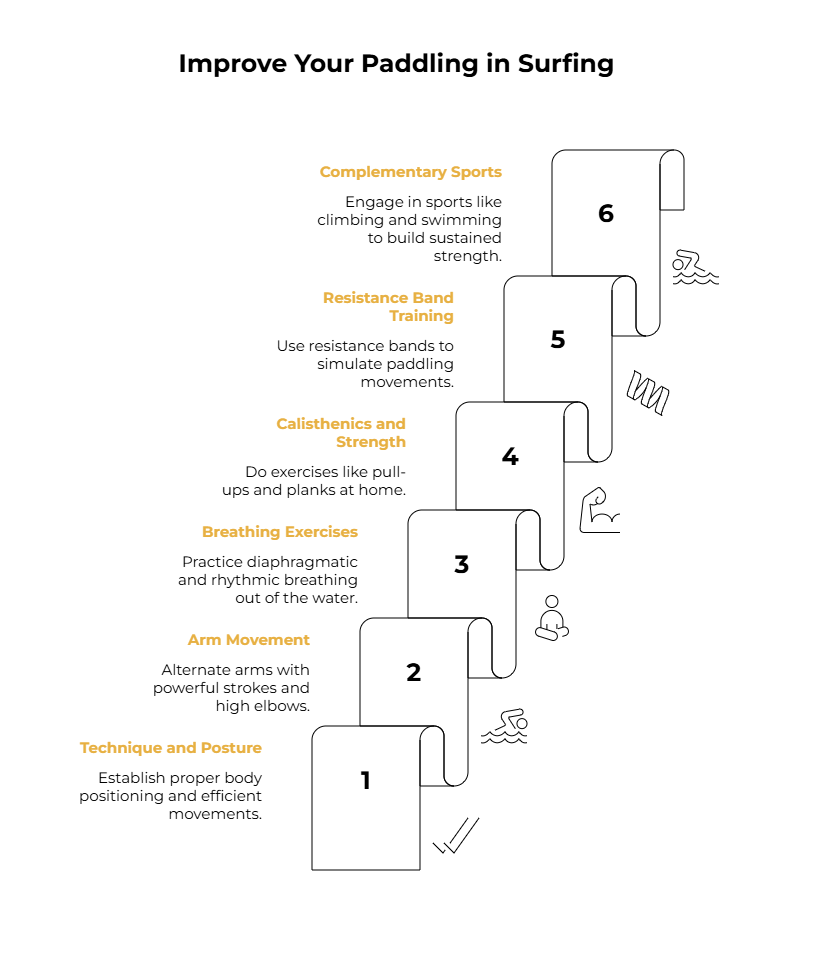
Focus on technique, posture, and breathing
A simple and effective way to achieve efficient paddling is to focus on technique, which includes paying attention to posture, movement, and breathing.
Before focusing on arm movement, it is essential to establish proper body positioning on the board
Your body should remain horizontal and centered, both longitudinally and laterally, to distribute weight evenly. Your legs and feet stay together and relaxed, without unnecessary tension. Your shoulders are active but not rigid, lifted just enough to keep your chest elevated off the board. Your core remains engaged at all times to reduce the impact of your body weight on the board and provide greater stability.
Proper positioning reduces water resistance and improves propulsion
Regarding the arms movement, they should alternate as in freestyle swimming (front crawl). In the first phase, extend your arm forward and enter the water as far ahead as possible, close to the rail of the board, without losing body posture (only the shoulders should rotate slightly, not the entire torso).
Then perform a powerful underwater pull, describing a slight “S” motion, always pushing the water backward and never downward.
It is important to keep your fingers together and your elbow high during both the pulling phase and the aerial recovery phase before the next stroke.
Breathing supports your paddling: inhale deeply through your mouth during the arm extension and exhale through your nose as you push the water once you reach the point of maximum contraction.
Practice breathing exercises out of the water
They will help you maintain control while paddling and improve endurance. You can practice diaphragmatic breathing and rhythmic breathing. Dedicating just 5 minutes a day to this practice takes very little time but will help make you a better surfer.
Calisthenics and endurance routine for surfers at home
There’s no need to go to the gym to improve your paddling. You can create a routine to do at home on days when you don’t go to the beach, when the weather doesn’t allow it, or to stay in shape if you live far from the coast and can only surf during certain times of the year.
One of the best exercises is the pull-up, widely used by swimmers as well. Remember its variations, such as the Australian pull-up (inverted row), seated row, and isometric holds — useful both to vary your training and to improve classic pull-ups.
It is also advisable to include a set of front planks and side planks to strengthen the core. Push-ups and prone back extensions using a fitball also help build the strength needed for effective paddling.
Dry-Land paddling simulation with resistance bands
Another very useful exercise to improve your paddling is to simulate on land the movements performed in the water. To make them more effective, use resistance bands that you can anchor under your feet or to a stable point in front of you.
Hold them in your hands and simulate the typical paddling pull, drawing your elbow backward to activate your lat muscles.
Practice sports that develop endurance strength
If you enjoy sports in general, it’s useful to know that many disciplines complement each other and help develop skills that are also beneficial for surfing.
Among the sports that promote endurance strength — essential for improving paddling in surfing — are climbing, boxing, and swimming.
Ultimately, improving your paddling in surfing is a process that combines technique, consistency, and small adjustments that make a big difference both in and out of the water. Working on posture, breathing, strength, and mobility will allow you to catch more waves, do so with less effort, and enjoy longer, more satisfying sessions.
It’s not just about paddling harder, but about paddling better — efficiently and consciously. If you can rely on proper guidance from the beginning, such as in beginner surf courses, your progress will be much faster and more motivating.
Start applying these tips gradually, and you’ll notice how your paddling becomes a true ally in continuing to progress and fully enjoy every session.