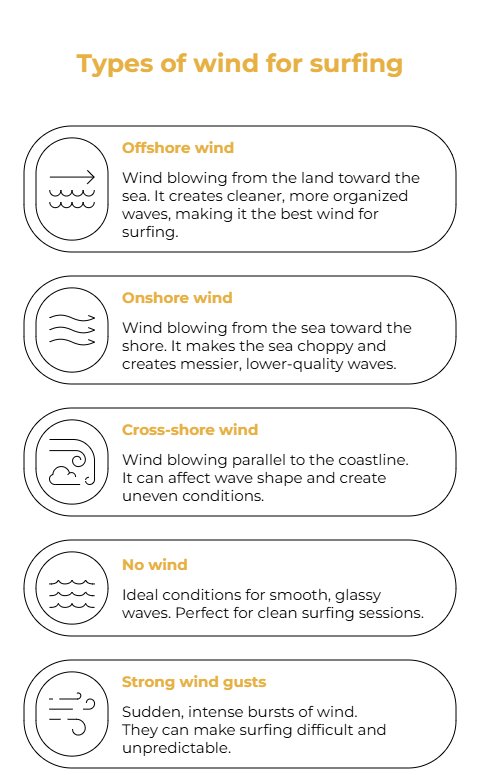
First of all, we need to clarify something that is often misunderstood. Surfing is very often practiced with wind, and it’s not correct to think that the best wave conditions only occur in the complete absence of wind or with very light winds.
The reality is more complex: wind is one of the main factors that determines the quality, shape, and power of waves. To understand this, it’s necessary to distinguish between the different types of wind and their effects on the sea.
Everything depends on its direction and intensity. There are clearly situations where the conditions are not ideal for enjoying this sport and may even be risky. Let’s look at these cases so you can decide for yourself whether the wind at your chosen spot is suitable for surfing or if it’s better to change location or postpone your session. And remember, we’ve also already covered how to read a surf forecast, so all of this can help you decide whether heading to the beach is a good idea or not.
Surfing in windy conditions: when can I surf?
Among people who are not very familiar with surfing, there is another common misconception: that surfing with wind is the norm because without wind there are no waves, as wind is directly associated with wave formation.
In reality, while wind does generate waves, the local wind near the coast is not necessarily the same wind that created them. For this reason, you can have waves at the beach even without local wind, because they may have been generated by a storm far away from the coast.
In general, there are different types of wind, with varying directions and intensities, and it’s important to know when wind is favorable for surfing and when it’s better to stay out of the water.
This is more than just a detail: it’s something you need to learn to truly enjoy this sport, which is not only about technique and practice. You can learn it at our surf school in Fuerteventura on surfintrip.com.
Surfing with offshore wind
Offshore wind blows from the land toward the sea, opposite to the direction of the waves.
When it is light or weak, with low intensity, it creates one of the best conditions for surfing. It organizes the waves and helps maintain both the crest and the wave face.
Depending on the seabed and other factors such as tide and wave period, offshore wind can help form clean, long tube waves, which are ideal for surfing. When it is present but light, it remains a perfect condition because it supports the wave face very well.
However, these conditions change when the wind becomes strong or very strong. The downside is that it makes paddling and catching waves more difficult. This effect can already be noticed with moderate offshore wind, as paddling requires significantly more effort.
In addition, when offshore wind is very strong, it affects the surfer’s visibility. The wind lifts the wave crest, causing water spray to hit the eyes, making it harder to see—this can be not only annoying but also dangerous.
Surfing with onshore wind
Onshore wind blows from the sea toward the land, in the same direction as the swell.
Its force pushes the wave crests forward, causing them to break in a messy way and creating more difficult surfing conditions, especially when it comes to reading and interpreting waves.
Most surfers think it is not suitable for surfing, but the reality is more nuanced because it also has some advantages. For example, it can help complete certain maneuvers thanks to the shape of the wave crest, improve observation and wave-reading skills, and force surfers to make better use of wave sections and body movements.
Surfing with side wind
Depending on the spot and the wind intensity, surfing with side wind can be enjoyable or a bad idea.
In general, this type of wind does not significantly hold or lift the wave crest. However, when it is light or low intensity and blows slightly across the front of the wave rather than from behind, it can create good ramps—perfect for having fun and performing certain maneuvers.
It’s important to note that side wind favors waves traveling in the same direction as the wind, while in the opposite direction it creates surface chop (“choppy” conditions), which can make surfing more difficult depending on the wind strength.
At the same time, these choppy conditions can favor aerial maneuvers, as wind opposing the direction of the ride helps keep the board under your feet.
You also need to consider wind direction and the spot’s geography. On more protected beaches, side wind can become a good ally for creating fun conditions.
- Side-off (slightly offshore): good for surfing
- Side-on (toward the shore): still surfable, but lower quality waves
Surfing with no wind
No-wind conditions are generally good for surfing because they often produce clean, well-shaped waves with smooth faces. They also make it easier to read the ocean and manage all the steps before catching a wave. It’s not entirely true that this is always the best condition, as it depends on many factors, but it is certainly one of the most favorable.
Surfing in strong gusty winds
When there are strong wind gusts, you need to carefully evaluate several factors before entering the water, as they can create strong currents, chaotic waves, and sudden changes in conditions. These are usually very difficult conditions, suitable only for experienced surfers. If the wind blows offshore, some good waves may still form, but catching and riding them becomes much harder.
Again, these are conditions best suited for experienced surfers and sometimes may not even be truly surfable.
Conclusion
We’d like to conclude by saying that “less wind” does not always mean “better waves.” Wave quality depends on many factors, including:
- swell direction
- local wind direction
- wave period
- tides
- seabed and coastline orientation
Wind can ruin a wave… but it can also create and improve it.
🌊 Want to enjoy surfing without complications? Come learn with us in Corralejo and discover with the best instructors how to read waves for a truly enjoyable surf day.